
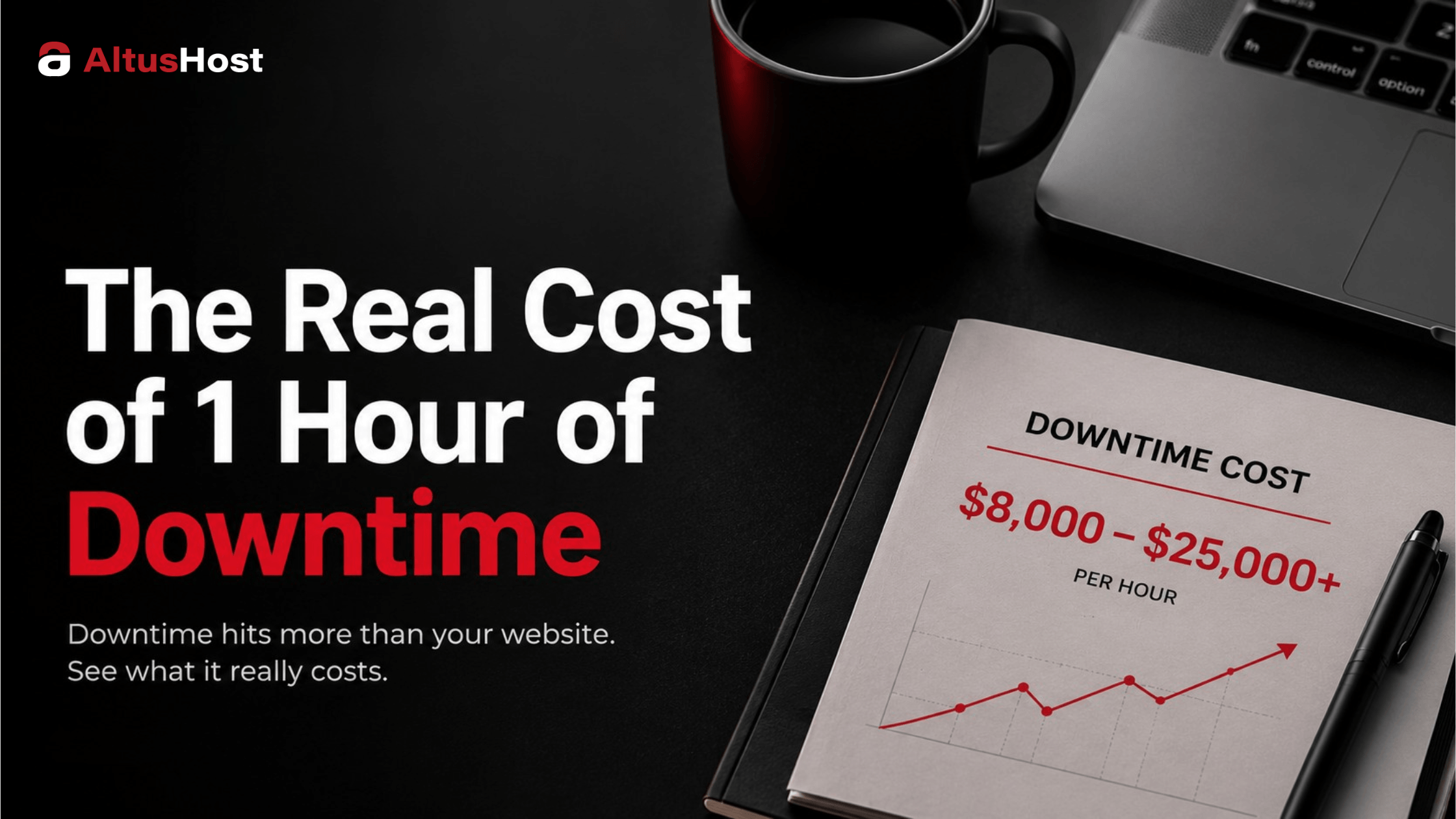
Ask any small business owner what an hour of downtime actually costs them, and most people guess low. The real number tends to surprise people, and not in a good way.
Industry research puts the average cost of downtime for small businesses somewhere between 137 and 427 dollars per minute. Do the math on a full hour and you land somewhere between roughly 8,000 and 25,000 dollars, and that is before you count what never shows up on an invoice: the customers who quietly do not come back.
This is not a Fortune 500 problem. Amazon and Facebook make headlines when their systems go down, with numbers in the tens of millions, but those figures do not apply to most businesses reading this. The smaller numbers above do, and they are still large enough to change how a month looks.
What One Hour Of Downtime Actually Means Depends On What You Run
An hour of downtime is not the same experience for every business, even at the exact same dollar value.
For an e-commerce store, it is lost sales, in real time, for as long as the store is down. No transactions complete. Cart abandonment climbs the moment the checkout page fails to load, and a meaningful share of those customers do not try again later. They buy from whoever happens to be online right now, which is rarely you.
For a SaaS product, it plays out differently. Revenue might not stop instantly if customers are on monthly contracts, but trust takes a hit immediately. Support tickets pile up, a status page gets screenshotted and shared in a Slack channel somewhere, and cancellations tend to tick up over the following weeks rather than the following hour. The cost shows up late, but it shows up.
For an agency managing client websites, an hour of downtime is a phone call you do not want to take. It is not your revenue on the line directly, it is your reputation with a client who trusted you to choose the right hosting partner in the first place. That conversation is harder to have than any invoice.
Same hour. Very different bill, and a different kind of damage depending on which one lands on your desk.
The Costs That Never Make It Into a Downtime Calculation
Most downtime math stops at lost revenue, but that is only part of it.
Employees still show up during an outage, they just cannot do their jobs. Support teams field the same question over and over. Developers drop whatever they were building to chase down the cause. None of that is free, it is just harder to put a number on than a missed sale.
Search engines notice too. A site that goes down repeatedly, or for long stretches, can see a measurable dip in rankings, since crawlers treat availability as a signal of quality. That is a cost that outlives the outage itself by weeks or months.
And then there is the simplest cost of all: the next time that customer needs what you sell, they remember the site that did not load, not the one that usually does. Loyalty is built slowly and lost quickly.
What Actually Causes Downtime
Most downtime does not happen because of some dramatic, unavoidable disaster. It happens because of a handful of predictable causes, repeated across almost every outage after the fact.
Single points of failure show up constantly, one server, one database, one network path, with nothing to fail over to if any part of it goes down. It works fine for months, until the one thing it depends on fails.
Unmanaged infrastructure is another common thread, nobody actively watching server health, so a slow degradation turns into a full outage before anyone notices something was wrong in the first place.
Monitoring that only alerts after the fact does not help much either. It tells you the site is down. It does not warn you it was heading that way, which is the version that actually lets you do something about it.
And then there is infrastructure sized for average traffic instead of peak traffic. It runs fine on a normal Tuesday and falls over the moment a marketing campaign, a sale, or a seasonal spike sends more visitors than the server was ever built to handle.
None of these are exotic. They are the kind of thing that keeps getting put off because everything has been fine so far, right up until it is not.
Why This Hits Harder During Peak Season
Downtime at 3am on a quiet Tuesday is bad. Downtime during a launch, a seasonal sale, or a marketing push that just went live is worse, because it happens at the exact moment traffic is highest and the cost per minute is at its peak.
This is also when infrastructure that was fine all year tends to show its limits. A server that comfortably handles normal traffic can struggle when a campaign sends several times the usual number of visitors in a short window. The irony is that the moments a business most needs its site to hold up are often the moments it is least tested to do so, simply because those spikes do not happen every week.
What a 99.9 Percent Uptime Guarantee Actually Covers
You will see 99.9 percent uptime on almost every hosting provider’s website, including ours. It is worth knowing what that number actually means, and just as importantly, what it does not.
99.9 percent uptime allows for a little under 45 minutes of downtime per month. That is the commitment a provider is making about its own infrastructure, and it typically comes with some form of service credit if they fail to meet it.
What it usually does not cover is downtime caused by your own application code, a plugin conflict, a misconfiguration on your end, or an attack large enough to fall outside standard protection. The percentage on the homepage is the easy part to compare between providers. What actually counts toward it, and what a provider does the moment something goes wrong, matters a lot more, and that only becomes clear if you read the actual SLA instead of the headline number.
How To Lower Your Downtime Risk Before Your Next Peak Season
You cannot get downtime risk to zero, but most of it is manageable well before it becomes a problem, usually with things that are more boring than they are difficult.
Start with your infrastructure. If your current plan was sized for last year’s traffic, and this year’s campaign, launch, or seasonal sale is expected to bring in more, it is worth checking whether your setup can actually handle it, rather than hoping it can.
Set up monitoring that warns you before an outage, not after. A server running low on resources almost always shows warning signs before it goes down completely. The question is whether anyone is actually watching for them.
Know your backup situation before you need it. A backup you have never tested restoring is a backup you are hoping works, not one you know works, and that difference only becomes obvious at the worst possible moment.
Ask your provider directly what happens when something goes wrong. Not the version on the marketing page, the actual answer: what counts as covered, what does not, and how quickly someone actually responds when it matters.
The Bottom Line
Downtime is one of those costs that is easy to underestimate until it happens to you. The businesses that handle it best are not necessarily the ones with the most expensive infrastructure. They are the ones who checked the boring stuff first, monitoring, backups, capacity, and what their SLA actually promises, before they needed any of it.
If you are heading into a busier season and are not entirely sure your current setup can handle it, we are happy to take a look and give you an honest answer either way.
The AltusHost Team
FAQ
Q: How much does one hour of website downtime cost a business?
For small businesses, industry estimates put the cost of downtime somewhere between roughly 8,000 and 25,000 dollars per hour, based on per minute averages of 137 to 427 dollars. Larger enterprises see far higher figures, often 300,000 dollars or more per hour, but that number is not representative of what most small and mid sized businesses actually experience.
Q: What is a 99.9% uptime guarantee and how is it measured?
A 99.9% uptime guarantee means a provider commits to no more than about 45 minutes of downtime per month. It is typically measured over a billing cycle and tied to service credits if the provider fails to meet it. It usually covers infrastructure level outages, not downtime caused by your own application, plugins, or misconfigurations.
Q: What actually causes most website downtime?
Most downtime traces back to a handful of predictable causes rather than dramatic disasters: single points of failure with no failover, infrastructure that nobody is actively monitoring, alerts that only fire after the site is already down, and servers sized for average traffic rather than peak traffic.
Q: Does downtime affect SEO rankings?
It can. Search engines treat availability as a signal of site quality, so repeated or prolonged outages can lead to a measurable dip in rankings. That impact tends to outlast the outage itself by weeks or months, which makes it one of the less visible costs of downtime.
Q: How can I reduce the risk of downtime during a product launch or seasonal sale?
Check whether your infrastructure is actually sized for the traffic you expect, not just your average traffic. Set up monitoring that warns you before an outage rather than after, confirm your backups actually restore, and ask your provider directly what their SLA covers during high traffic periods.
Q: Is having a backup enough to protect against downtime?
A backup on its own only helps after something has already gone wrong. Reducing downtime risk also depends on proactive monitoring, infrastructure sized for peak traffic, and eliminating single points of failure, so a backup is one part of the picture rather than a complete solution.